
Videolaryngoscope Technology
A patented dual-channel design that solves the critical problem of lens contamination during difficult airway management.
The Clinical Problem
During emergency airway management, lens contamination with blood, secretions, or fogging impedes visualization at the most critical moments.
In 25% of difficult airway cases, current solutions fail due to contamination from blood, secretions, or vomitus. No current training solution prepares healthcare providers for contaminated airway management.
Evidence-Based Statistics
- 24.8%of cases affected by lens fogging
- 61.3%first-pass success when fogging present (vs 87.6% overall)
- 15.1%of cases with blood on camera lens
- 81.5%first-pass success when blood present (p=0.02)
Source: Knapp et al., Scand J Trauma Resusc Emerg Med, 2021
Clinical Impact
In 1 out of every 4 emergency intubations, lens fogging impedes visualization. Vomit in the pharynx was observed in 21.5% of cases overall and 32.4% of CPR patients.
This is exactly the problem the Pavisus dual-channel design solves.
Clinical Impact: These findings demonstrate that existing videolaryngoscopes perform well under ideal conditions, but visual impediments remain a significant challenge in the 25% of cases where they occur—exactly the problem the Pavisus dual-channel design addresses.
Our Solution: Dual-Channel Architecture
The dual-channel blade provides three critical functions in a single disposable blade:
Channel 1: Suction
High-flow suction (>1,000 mL/min) clears blood, secretions, and vomitus from the airway without removing the blade.
Channel 2: Insufflation
Oxygen and medication delivery (15 L/min) maintains oxygenation during intubation attempts, prevents lens fogging, and enables atomization of local anesthetics for awake intubation procedures.
Continuous Visualization
Active lens cleaning restores visualization when the camera becomes contaminated. The dual-channel design maintains clear visualization throughout the intubation attempt.
Modular Design: Disposable blade with reusable handle enables infection control through single-use blades while reducing cost through handle reuse.
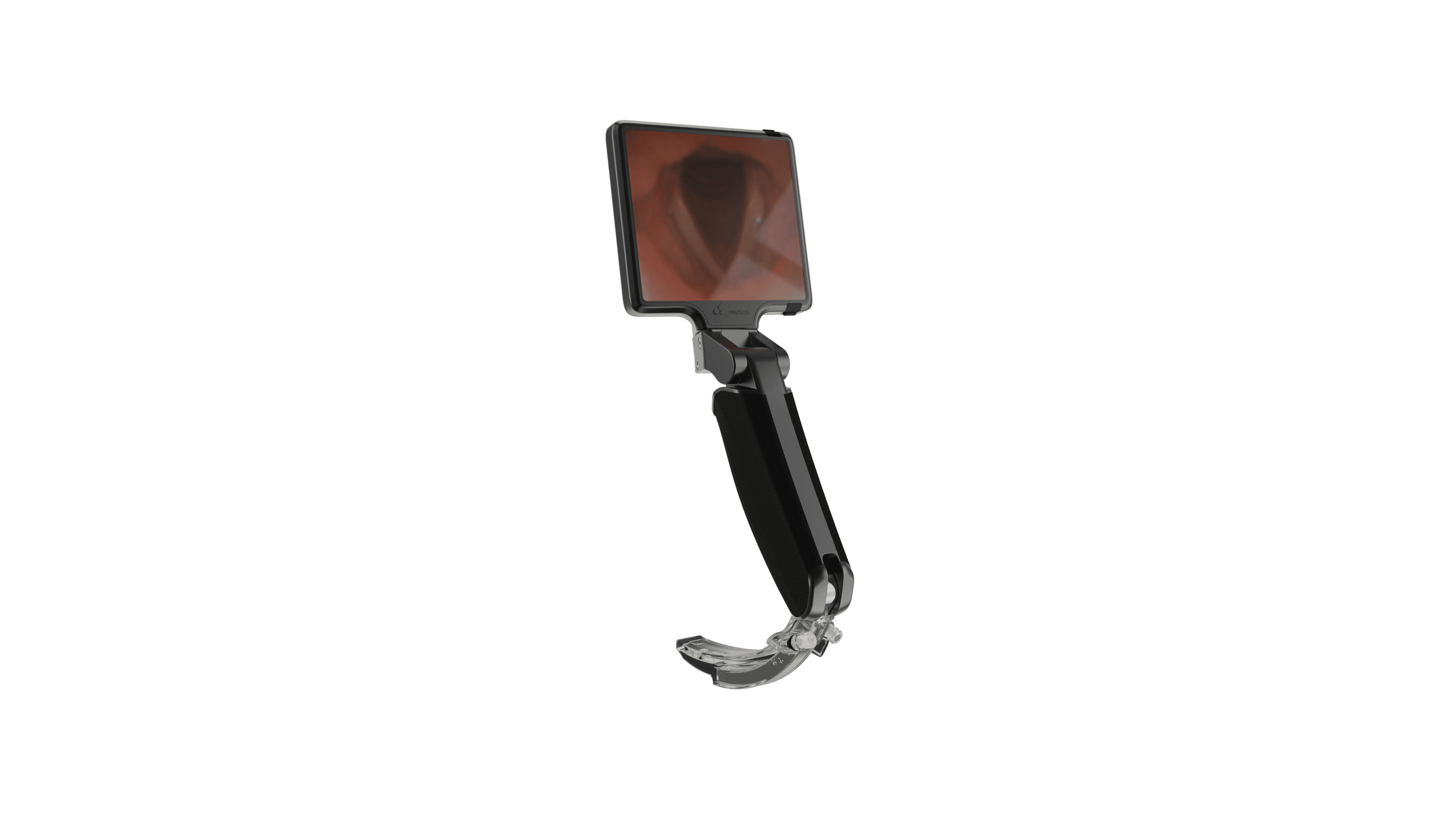
Pavisus dual-channel videolaryngoscope with airway visualization
Competitive Landscape
No competitor offers integrated suction, oxygen delivery, and lens cleaning in a single blade. This is a first-mover opportunity.
| Competitor | Contaminated Airway Solution |
|---|---|
| Verathon (GlideScope) | None |
| Medtronic (McGrath) | None |
| Karl Storz (C-MAC) | None |
| Ambu (aScope) | None |
| Pavisus | Integrated dual-channel system |
Patent Portfolio
US 12,201,276 B2
Dual-channel blade technology
- Protection through 2043
- Zero prosecution risk
- Fully granted status
US 11,690,506 B2
Adjustable positioning mechanism
- Protection through 2041
- Zero prosecution risk
- Fully granted status
International Coverage
PCT WO2022/009050 - European patent under examination (EP 21739800.7). Applications active in Korea, China, Canada, and Australia.
Expert Validation
Professor Andre van Zundert, FRCA, MD, PhD, MBA
500+ publications in airway management | Editor-in-Chief, Trends in Anaesthesia and Critical Care
"By addressing core technical limitations through integrated engineering solutions rather than external attachments, this approach may help establish videolaryngoscopy as the standard for first-line use in all intubations."
— Letter to the Editor, Anesthesia & Analgesia, 2025
Market Opportunity
Interested in Partnership?
We're currently in discussions with strategic partners for commercialization. Contact us to learn more about partnership opportunities.
Contact Us